
After her mother died when she was just five months old, Miranda Malone grew up grieving a relationship she never had the chance to experience. Now a mother and licensed clinical social worker, she shares how that grief has shaped her life – and what she wishes adults understood about supporting grieving children.

Photo courtesy of Miranda Malone.
Miranda Malone doesn’t remember her mother.
She doesn’t know what her voice sounded like or what it felt like to be held by her. She has no memories of conversations, bedtime stories, or the everyday moments that shape a relationship between a mother and daughter.
Her mother, Rosalie, died when Miranda was just five months old.
For much of her childhood, Miranda struggled to understand what that meant. She knew her mother had died, but she didn’t yet have the words to describe what it felt like to grow up without her.
“I never really had the tangible words or understanding for what happened,” she recalls. “I didn’t know the questions to ask.”
Today, Miranda is a licensed clinical social worker, certified hypnotherapist, and mother. She’s also spent much of her adult life learning to understand her own grief; grief that began before she could speak and continues to evolve decades later.
Her experience challenges a common misconception about childhood grief: that children who were too young to remember someone who died have less to grieve.
For Miranda, the absence of memories has always been part of the grief itself.
Grieving Someone You Never Knew
Miranda was raised by her father, who was just 23 when he took custody of her after her mother’s death, along with the support of grandparents and extended family.
She describes her childhood as one surrounded by love. Her paternal grandparents were deeply involved in her upbringing, and her grandmother helped keep her mother’s memory alive.
Still, conversations about Rosalie were limited.
Her father rarely brought her mother up unless Miranda asked. Other relatives found it difficult to talk about her. As a child, Miranda didn’t always know what to ask or how to express what she was feeling.
She remembers an elementary school Mother’s Day assignment that asked students to write a poem. The words didn’t fit her experience, so she had to change them.
Looking back, that assignment became a metaphor for her childhood.
The pieces were there, but they didn’t quite fit together.
“Confusing and vast,” is how she describes grieving her mother as a child. “It just felt untethered.”
For children who experience the death of a parent before they can form lasting memories, grief may look different from what adults expect. They may not miss specific conversations or shared experiences. Instead, they may grieve the relationship they never got to have, the stories they don’t know, and the milestones their parent will never share.
Miranda has encountered people who questioned how she could grieve someone she didn’t remember.
“The absence of my having a relationship with this woman in and of itself is the trauma,” she explains.
It’s a distinction she wants other grieving children and adults to understand.
“Your grief is just as valid, just as valid. It’s different and it looks different and it feels different. It shows up different, but it’s no less valid.”
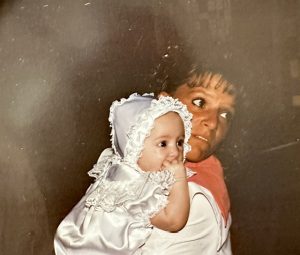
An infant Miranda with her mother Rosalie, one of the few photos she has with her mother. Photo courtesy of Miranda Malone.
When Grief Doesn’t Look Like Grief
As a child, Miranda was a high achiever.
She earned excellent grades, excelled academically, and pushed herself to succeed. From the outside, there was little reason for adults to believe she was struggling.
But looking back, Miranda recognizes that some of her drive to succeed was connected to her grief.
“I never wanted anyone to think that I couldn’t do something because my mom died,” she says.
She wishes the adults in her life had recognized that a child can appear to be thriving while still needing emotional support.
“I just wish that there would have been conversation or dialogue even between my family and school or other caregivers,” she says.
Miranda’s experience highlights something important: grief doesn’t always look like sadness.
For some children, grief may show up as changes in behavior, difficulty concentrating, frustration, or withdrawal. Others may become especially focused on achievement, take on additional responsibilities, or work hard to appear as though everything is fine.
And sometimes, children simply don’t have the language to explain what they’re experiencing.
Miranda remembers experiencing intense emotions after a breakup in high school. At the time, she knew her feelings went beyond the end of a teenage relationship, but she couldn’t fully understand why.
It wasn’t until adulthood, and her own experience with therapy, that she began recognizing connections between her early grief and the ways she navigated relationships.
Her story is a reminder that adults shouldn’t assume a grieving child is doing fine simply because they’re succeeding in school, participating in activities, or not openly expressing sadness.
Sometimes, the children who appear to be managing everything still need someone to ask how they’re really doing.
Childhood Grief Grows With Us
One of the most important things to understand about childhood grief is that it doesn’t follow a straight line.
As children grow, their understanding of death changes. They develop new relationships, encounter new milestones, and begin to recognize different dimensions of what it means to live without someone important to them.
A child who grieves at five may experience that same death differently at 15, 25, or 35.
For Miranda, one of the most profound shifts came when she became a mother herself.
Holding her infant son gave her a new understanding of what she had experienced decades earlier.
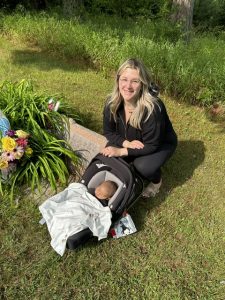
Miranda and her son at Rosalie’s grave. Photo courtesy of Miranda Malone.
“I just remember having him and looking at this newborn baby, essentially, you know, four or five months old. And for the first time in my three plus decades of life, I was able to conceptualize exactly what it was that I lost.”
Becoming a parent brought both joy and a new layer of grief.
“Having my son cracked my grief open in ways that I never expected it to, and also healed me in ways that I never expected it to,” she says.
Miranda had always known her mother died when she was an infant. But becoming a mother helped her understand that experience from an entirely different perspective.
It’s an example of how childhood grief can resurface at significant moments throughout life – not because someone has failed to move forward, but because their relationship to the death continues to change as they grow.
Children don’t simply finish grieving and move on. They grow around their grief, discovering new questions, feelings, and perspectives along the way.
“I Wish They Said Her Name a Whole Lot More”
When asked what she wishes the adults in her life had done differently, Miranda doesn’t hesitate.
“I wish they said her name a whole lot more.”
She wishes there had been more photographs of her mother in the house. More stories about what she was like. More conversations about the things she loved, the way she laughed, and the person she was.
And she wishes the adults around her had felt comfortable showing their own sadness.
“I wish that everyone being sad was like, okay, why are we avoiding that? Someone died. That is sad.”
She continues, “We could all just be sad together and have that be okay.”
For caregivers, family members, and other adults supporting grieving children, Miranda’s reflections offer a meaningful reminder: talking about someone who died doesn’t have to be something we avoid.
Children deserve opportunities to remember, ask questions, share feelings, and learn about the people who are part of their stories.
That might mean keeping photographs visible, sharing a favorite memory, celebrating a birthday, or simply saying someone’s name during an ordinary conversation.
It also means allowing children to see that sadness is a natural part of loving and missing someone.
Miranda especially treasures the moments when family members tell her she reminds them of her mother.
Those connections help her understand who Rosalie was and recognize pieces of her in herself.
For someone who grew up without memories of her mother, those stories are invaluable.
Why Community Matters for Grieving Children
Despite the challenges she experienced, Miranda is quick to acknowledge the love and support that surrounded her throughout childhood.
Her father, grandparents, and extended family helped raise her, and she credits them with shaping the person she is today.
But when asked what else might have helped, she points to something she never had as a child: a community of other young people who understood what it was like to have a parent die.
“I wish that I had a grief camp to go to as a child,” she says.
Miranda believes children need opportunities to connect with others who have experienced similar deaths, express themselves through play and creativity, and explore their emotions without feeling pressure to protect the adults around them.
“If I had had a me at 13, I don’t know where I would be now,” she reflects.
That’s part of why spaces like Experience Camps matter.
At Experience Camps, grieving children have opportunities to connect with peers who understand what it’s like to have someone important die. Through camp activities, shared experiences, and the support of caring adults, children can experience moments of joy, connection, and belonging while knowing there’s room for their grief, too.
They don’t have to explain why they feel sad on a particular day. They don’t have to be the only child in the room whose parent or sibling has died. And they don’t have to choose between having fun and missing someone they love.
Both can exist together.
For Miranda, that’s what she hopes more adults understand about supporting grieving children.
Rather than trying to protect children from every difficult feeling, she encourages caregivers to create environments where those feelings can be expressed safely.
“How can I create spaces for my child, or for this child, to have really hard feelings and have them be held, not avoided?”
A Lifetime of Grief, Love, and Connection
Today, Miranda continues learning about her mother through the people who knew her.
She collects stories, photographs, and memories, knowing that much of what she understands about Rosalie comes from the people who loved her.
One of her favorite stories is about her mother’s determination.
As a young woman, Rosalie confronted her own father about his absence from her life, speaking openly about how his choices had affected her family.
Miranda admires her mother’s willingness to stand up for herself.
And when relatives describe Rosalie as headstrong, outspoken, and fiercely independent, Miranda recognizes those same qualities in herself.
“Every time I hear that story, I’m just reminded of how much of Rosalie’s daughter I am,” she says.
It’s a connection she carries with pride.
For Childhood Grief Awareness Week, Miranda’s story reminds us that grief doesn’t require memories to be meaningful, and it doesn’t disappear simply because a child grows up.
The five-month-old who experienced her mother’s death became a little girl trying to understand her family, a teenager navigating relationships, and eventually a woman raising a child of her own.
At every stage, her grief has meant something different.
And at every stage, she has remained Rosalie’s daughter.
Childhood grief doesn’t end with childhood. But with understanding, connection, and support, grieving children can grow up knowing their experiences matter, their feelings belong, and they don’t have to navigate grief alone.
This Childhood Grief Awareness Week, help us make space for the millions of children navigating the death of someone important. Learn more about how Experience Camps creates opportunities for grieving children to experience connection, belonging, and joy at experiencecamps.org.

